In Paris, where summer Rendez-Vous is wide open,
on Seine, at Eiffel Tower, along Champs-Élysées,
blue for liberty, white for Equality, red for fraternity,
5 rings connect each other, and Olympic spirit shines over,
sports unite world and green dreams take flight.
Olympic Games, record-breaking season, gold victories, purple track, pink design, green arenas, yellow torch and red flame…Paris 2024 is absolutely one of top headlines for this summer, millions of world audience are watching, experiencing and cheering the spirit and celebration of sports.
Now September has just started, summer continues until the end of month. Paris 2024 returned for the 2nd summer rendez-vous with the Paralympic Games, which opened last Wednesday at the Place de la Concorde, following by the popular athletes parade walked through the famous Avenue des Champs-Élysées. It was nearly 2 kms from the Arc de Triomphe de l’Étoile to Place de la Concorde, a super big ceremony full of music, dance, carnival lights and evening sunset.
 For the 1st time in history, the Paralympics had the opening ceremony outside of a stadium, in the open space and crowded streets right at the heart of Paris. 2 weeks after the Summer Olympics’ successful completion, the French capital was transformed into a huge sports ground again in tricolor style of blue, white and red.
17th Summer Paralympics (Wed Aug 28 – Sun Sept 8, 2024)
Paris hosts its Paralympic Games for the 1st time, it’s also the 1st Summer Paralympics and the 2nd Paralympics to take place in France, after the 2 cities of France held the 1st Winter Paralympics in 1992. This summer, Paris games bring together around 4,400 athletes from a record of 168 delegations all over the world, to compete each other in 549 medal events across 22 sports.
The Paralympics history began 76 years ago in Stoke Mandeville, a village in England as the historic origin and symbolic birthplace. In 1960, the very 1st Paralympic Games was held in Rome, Italy. Since then, the para sports have developed quickly alongside the Olympic Games.
Paris 2024 set a new tradition in Paralympics history, to promote Stock Mandeville as the official starting place for the Paralympic flame from this year. The Paralympic Flame was lit in Stock Mandeville 4 days before the opening on August 28, embarked a unique journey and crossed the sea to France. 24 British athletes symbolically carried it from UK, and entered the Channel Tunnel to meet halfway with 24 French athletes, who took over the flame and went through the Channel Tunnel to Calais, a port city in northern France.
Then it’s split into 12 separate flames, which were spread widely and formed a ring around the country to launch the torch relay on day 3. One of them was lit specially in Paris on Aug. 25 to pay tribute to the history, and commemorate the 80th anniversary of the Liberation of the French capital during World War II.
On opening day, 12 flames were all delivered to Central Paris to match 12 days of the Games. A total of 1200 torchbearers carried the flames over 50 cities in different parts of the Relay, including key volunteers, former and future Paralympians, disability support workers and caregivers etc.
The relay was ended and 12 flames became only one again to ignite the modern cauldron balloon, which is designed like a 30 meter tall helium sphere and represents freedom as part of French National motto: Liberté, Egalité, Fraternité (Liberty, Equality, fraternity). In the opening ceremony, the hot air balloon was lighted up in glowed gold and rose into the sky, to keep floating above Jardin des Tuileries. While the Paralympic flame shines over Paris with the flying cauldron, the Paralympics continue on day by day with the intense competition until this Sunday.
Spirit in Motion is the Paralympic motto, to represent Paralympian’s
strong will and inspiring performance: always moving forward and
never giving up.
33rd Summer Olympics (July 26 -Aug. 11, 2024)
As the biggest event ever organized in France, Paris 2024 launched a unique outdoor ceremony to open up the Games on July 26. For the 1st time in Olympic history, the opening ceremony was held on a flowing water outside of an arena, featuring the athletes parade sailed along the river Seine by electric boats through the center of Paris.
The both banks were covered by a big crowd of 2200 spectators, star-filled shows, artistic performance and splendid fireworks…From Eiffel Tower to Louvre Pyramid, from Notre Dame Cathedral to Grand Palace, many iconic monuments and landmarks were illuminated as a perfect backdrop, the beautiful river Seine was transformed to a world stage in French tricolor of blue, white and red.
100 years later, Paris hosted Summer Olympics again, much bigger and wider. 206 countries joined Paris 2024, over 10 thousand athletes participated in 329 medal events, for a total of 32 sports and 48 disciplines including 4 newly added sports: skate boarding, sport climbing, surfing and breaking.
In 1900, Paris had its 1st Summer Olympics with 26 nations, around 1200 athletes competed 19 sports and 21 disciplines in a total of 95 medal events. In July 1924, Paris held its 2nd Summer Olympics with 44 participating nations, around 3000 athletes competed in 126 medal events for 17 sports and 23 disciplines. More special about Paris 2024, which also marks a centenary of the 1st Winter Olympics in France’s Chamonix. With Paris 2024, the French capital became one of the 2 cities in the world to host 3 times of Summer Olympics right after a century.
 19 days of competition and 754 sporting sessions, Paris 2024 has 120 Olympic records broken in 10 disciplines, and 32 world records broken in 8 disciplines including swimming, track cycling, sport climbing, archery and athletics etc. About 10 millions of spectators gathered in Paris, packed over 30 sports venues and tons of celebration sites, plus billions of worldwide viewers and followers, Paris is truly this summer’s sporting capital of the world.
Besides 328 gold medal winners in Paris 2024, a total of 5084 medals were won by over 80 NOCs (National Olympic Committees), and each of them is made by using 18 grams of original iron from the Eiffel Tower. With an environmental approach and sustainable purposes, the production of medals are 100% recycled and certified with reusable metal and materials.
As the most prestigious award of Paris 2024, medals are designed to make a symbolic and eco-friendly craft, with a creative concept inspired by Olympic history and French heritage. On the front side, a piece of genuine iron of the Eiffel Tower is formed a hexagon in its original color, to display France’s geometrical shape and Paris 2024 emblem in the middle, surrounded by smooth lines and radiant colors. On the back side of, it’s the Greek goddess of victory Athena Nike and the Panathenaic Stadium in the middle to represent the modern Olympic Games history since 1896, images of the Acropolis of Athens and the Eiffel Tower are shown as the backdrop, for a combination of the ancient Games in Greece and the rebirth of modern Olympics by French initiative. 
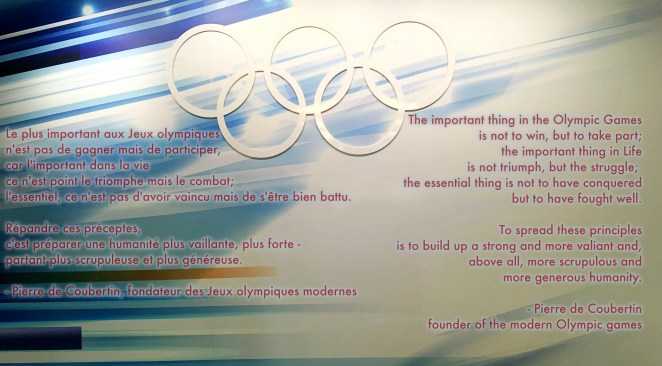
L’important, n’est pas de gagner, c’est de participer.
The important thing is not to win, it is to take part.-Pierre de Coubertin, pédagogue français et fondateur visionnaire des Jeux Olympiques modernes / French educator and the father of the modern Olympic Games
Sports for all
Born in Paris, Pierre de Coubertin is known as the founder of the Olympic Movement and former president of the International Olympic Committee(IOC). He was a French historian and a champion of sport in education, which led his path to be a key figure in the modern Olympic Games history over 100 years ago.
In June 1894, the 1st Olympic Congress took place in Paris to resume the Olympic Games, and the IOC was officially founded by Pierre de Coubertin’s initiative. In 1896, the 1st Summer Olympics happened in Greece, where is the home of ancient games with the birthplace of the Olympic Games in Olympia. Since then, the quadrennial Olympics have taken a Greek tradition of lighting a sacred fire for the Olympic flame, which is lit in Olympia to start the Torch relay from Greece to the host nation and city, ahead of the Games’ opening.
By unifying Olympism and Paralympism, the torch is a symbol of ancient and modern games, to carry the flame as the light and energy throughout the relay across the world. They spread the positive message of peace and unity, manifest widely the Olympic spirit and Paralympic values about sports without barriers.
The torch relays vary in time and distance for different Games, usually come with a large number of torchbearers through the routes. In Olympic history, the shortest relay occurred only about 2 days for Oslo 1952, and the longest relay lasted 142 days for Athens 2004. The longest relay was 137,000 km (85,000 mi) for the 29th Olympics, it’s Beijing 2008 global relay entitled by the Guinness World Record. Also Beijing 2008 holds a record of the most torchbearers in a single relay, where 21,800 torchbearers officially handled the torch along the route, helped bring the flame around the world to China and its capital.
This summer, the Olympic torch relay was taken 68 days and covered 3100 miles for Paris 2024, over 10 thousand torchbearers participated in the relay with a gender parity between men and women. From gender parity to equality, the torch itself also represents the Games’ identity and vision through a unique and radiant design:
– a perfect symmetry between upper and lower parts, as well as left and right parts for equality and unity of men and women respectively
– 3D waves and vibration effects on the bottom match water ripples and movements of the Seine as the heart of the city, to reflect the iconic river and its pivot role for Paris green games in open and natural spaces
– a curved shape and rounded lines with gentleness and radiance convey peace and harmony, generosity and solidarity
For the 1st time, the Olympic and Paralympic Games shared the same torch design, as well as the emblem and mascots, equality was just a driving force behind the torch making and the both Games. Besides the 3 themes of equality, water and peacefulness, the torch is distinguishable primarily by its champagne color, which drew inspiration from French wine culture with natural light to present the image of Paris 2024. The reflections of light on its polished surface, particularly showcases Paris for being known as the City of Light. Made from recycled steel, the torch became a piece of green art to embody French culture and impact through Olympic history and Paralympic movement.

Women in Sport
Over a century ago, when Pierre de Coubertin was the 2nd president of the IOC from 1896 to 1925, Paris hosted its 1st Olympics and the 2nd modern Summer Olympic Games in 1900. It was the 1st Games to include women participants, who were 22 out of nearly 1000 athletes to participate in sailing, tennis, golf, croquet and horse riding. Among them, Swiss sailor Helene de Pourtales was the 1st female Olympic champion, a historical moment was made in Paris Games.
In 1924, Paris held its 2nd Summer Olympics with the 1st Olympic Village for all athletes to stay inside. 135 women athletes attended comparing to a number of 2950 sportsmen, they participated in diving, fencing, swimming and tennis without being admitted in track and field events. In the same year, the 1st Winter Olympics took place in Chamonix, France, with a participation of around 260 athletes representing 16 nations for 16 competition events, and 11 female olympians competed in figure skating for ladies’ singles.
 Right after 100 years, Paris 2024 made history as the 1st Olympics to achieve full gender parity. 5250 male and 5250 female athletes competed on the field of play with a numerical balance of 50:50, the equal representation demonstrated a great progress of diversity and inclusion on a global scale for the Olympic participation, irrespective of social background, gender, race, physical appearance, sexual orientation or political belief etc.
A total gender parity was also realized in the Paris 2024 organizing committee and the executive board, with the same number of male and female staff members for 50/50 gender balanced. Among 45,000 volunteers, women were accounted as a half. The women’s marathon was done on the final day of Paris Olympics, 3 female medalists were awarded in the closing ceremony to highlight women athletes and their performance in the Games.
From the athletes parade on the opening night to the athletes marching to close out the Games, around 196 delegations (96% of NOCs) selected a due of flag bearers with one male and one female olympians, to carry their respective flag in front of a global audience, including Australia, Canada, France, Italy, Mexico, China, UK and USA etc.
Just one day before the closing of the Summer Olympics, Paris 2024 organized a Marathon for All (Marathon Pour Tous), and more than 48,000 runners took part in this first-ever mass public event. Again, the spots were split equally between male and female participants of all abilities with a gender balanced proportion.
2 routes were open to the massive public participation, one had a longer distance of 42km to run across the Parisian region, it’s designated as a special tribute to the Women’s March from Paris to Versailles during the French Revolution in 1789. The other one was a 10km race from City Hall (Hôtel de Ville) to House of Invalides (Hôtel des Invalides), and additional 20,000 runners participated in this shorter route around the heart of Paris for a midnight marathon.
 Open to all and open big, Paris 2024 made its efforts to reduce the gender-based imbalance in the both Olympic and Paralympic Games. In Paris’ 1st ever Paralympics, a record number of nearly 2000 female competitors joined this summer than ever before. Among them, 2 notable athletes include Australian Melissa Tapper and Brazilian Bruna Alexandre, who are both table tennis players to compete in both Games at Paris 2024.
As one of the world’s biggest multi-sports event, Paris Paralympics took women’s sport and the largest sports into a new dimension. Para athletics had the most competitors of 1135 athletes in 164 medal events, Para swimming was the 2nd one starring 608 athletes in 141 medal events, the 3rd one was Para table tennis with 281 athletes in 31 medal events. During the 11 days of competition, the Games were featured more medal events for woman than ever before, female paralympians represented 45% of the total athletes and contested in 235 events, which were 8 more than the last one 4 years ago.
With a fair participation and equal share of representation as much as possible, Paris 2024 has set new benchmarks for sportswomen to shine more brightly on the world stage. This Summer Olympics belonged to women athletes, who led males in the medal standings and beat many records along the way. More and more countries have women dominance to win more medals with their excellent competition:
– Australia, 30 female medals, 20 male medals, 53 total medals including 3 mixed gender medals
– Canada, 17 female medals, 9 male medals, 27 total medals including 1 mixed gender medal
– China, 50 female medals, 34 male medals, 91 total medals including 7 mixed gender medals
– Netherlands, 21 female medals, 11 male medals, 34 total medals including 2 mixed gender medals
– South Korea, 17 female medals, 10 male medals, 32 total medals including 5 mixed gender medals
– USA, 67 female medals, 52 male medals, 126 total medals including 7 mixed gender medals
At Paris Paralympics, 15 Para sports boast more female competitors than the last Summer Games, such as archery, athletics, badminton, cycling, shooting, swimming and table tennis etc. 2 of them have more females than males, 4 of them have achieved gender parity for the competitors, and 3 Para sports are almost gender balanced for the competition events:
– female competitors > males: equestrian (61F/17M), powerlifting (90F/89M)
– female competitors=males: badminton, goal ball, rowing, wheelchair basketball
– almost female competitors=males: teakwondo (60F/61M), wheelchair fencing (48F/49M), sitting volleyball (91F/96M)
Furthermore, 35 NPCs (National Paralympic Committee) featured a record number of female athletes, and 27 delegations have more female than male paralympians for competition, they are Canada, China, Italy, Ireland, Mexico, Norway, Singapore, Switzerland, Sweden and so on. Some delegations like Mauritius, Nepal and the Refugee Paralympic Team, even made history by winning their 1st ever Paralympic medals. Among the top 5 largest delegations, China topped the medal table for the 6th consecutive participation since their debut at Athens 2004, followed by Great Britain and USA, the host nation France finished at the No. 8 position:
– China is the largest team with 282 athletes: 124 men and 158 women
– Brazil is the 2nd largest team with 255 athletes: 138 men and 117 women
– France is the 3rd largest team with 237 athletes: 155 men and 82 women
– USA is the 4th largest team with 220 athletes: 110 men and 110 women
– Great Britain is the 5th largest team with 201 athletes: 109 men and 92 women
Paris Rendez-Vous
Paris is well known for its rich history and revolutionary heritage, iconic monuments and beautiful scenery along the river Seine, feminine influence and Parisian culture of liberty, equality and fraternity (Liberté, Egalité, Fraternité).
In 18 century, Paris was the symbolic center of French Revolution for major change in social and political movements. In 19 century, Paris had the July Revolution to remove the King and fight for freedom. The historic moment of people’s marching and fighting was captured by the French artist Eugène Delacroix at that time, in his Romantic painting of Liberty Leading the People (La Liberté guidant le peuple) as one of masterpieces in that Romantic era.
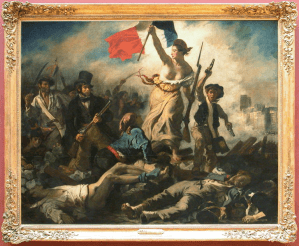 A brave woman holds aloft the French tricolor flag as the Goddess of Liberty, and leads a group of people forward over the bodies of the fallen…The concept of Lady Liberty represents the rise of people’s power, and is viewed as Marianne who is the glorious symbol of the French Republic. Throughout the following 200 years, the leading female figure has presented largely in French culture and values.
This summer, Marianne as the renowned feminist symbol is the face of Paris 2024, to reflect French identity and heritage on this global platform. Marianne is the personification of France, and a universal icon embodied by influential and determined women for strength, youth and feminism. Her image was shown and designed on the emblem for Paris 2024, to represent the same values in sport: humanism, fraternity, generosity and sharing.
From lips to hair, Marianne’s face is combined with the gold medal color and the shape of the flame to signify the Olympic spirit and feminist inspiration: championship, energy, freedom and strength. More inspiration and bold creativity were unveiled at Paris 2024, 10 statues of golden women were installed to emerge majestically from the river Seine, they are feminist figures and activist heroines in the last centuries, including Simone de Beauvoir (1908-1986), Olympe de Gouges(1748-1793), Simone Veil(1927-2017), Alice Milliat(1884-1957), Gisèle Halimi(1927-2020), Paulette Nardal(1896-1985), Jeanne Barret(1740-1807), Christine de Pizan(1364-1431), Alice Guy(1873-1968) and Louise Michel(1830-1905).
With an equal share of the spotlight and leading heroine figures, Paris 2024 opened a new era for women in sport, women played important roles in French history and ruled this sporting summer. The successful Games sustained the strong commitment to equality, accessibility and inclusion at the largest sporting event in the world. From gender inequality to gender parity, it takes more than 100 years to develop and achieve through generations. Achieving gender equality in full takes strength, perseverance, leadership and courage, it’s a long way to come here and another long way to go further, for universal sports with inclusivity, solidarity and resilience by everyone’s participation.
Along with Marianne’s face, 2 little red Phrygian caps are also seen all over the places as the official mascots of Paris 2024. Popular and active at the major sports events around Paris, they are designed and distributed by a French sme(small and medium-sized enterprise) like soft plush toys and collectible objects, which are shown in pair to carry French spirit and values for togetherness and revolution through worldwide sports.
Historically, the Phrygian cap is a revolutionary symbol of French Republic with a renowned long tradition in many important movements. From the building of the Cathedral of Notre-Dame de Paris in 1163 to the French Revolution in 1789, its appearance and strong meanings started a thousand years ago through the country’s rich history. This summer, it has a mission of liberty and freedom to get the world moving up to the Games and beyond.
 Sport in all of its forms is a creator of social ties and inclusion, sports for all enable people to get involved with sport, as many as possible on a regular basis. Paris 2024 demonstrated a new progress to make the Games accessible to everyone, and welcome the entire world, from athletes to spectators, who benefit as much as possible the positive impact of the universal Games.
Associating with French motto “Liberté, Egalité, Fraternité”, the universal concept emphasizes the 3 Olympic values of excellence, respect and friendship, which are the foundation of the Olympic movement to promote sport, culture and education for a better life. At Paris 2024, the 15 thousand athletes accessed to free medical treatment by French universal healthcare coverage. A polyclinic opened in the Olympic and Paralympic Village to accommodate the athlete residents with a wide range of free healthcare services, including cardiology, orthopedics, physiotherapy, podiatry, dermatology, sports medicine and dental etc.
This multi-functional medical centre also offered 24 hours emergence service in collaboration with the Greater Paris University Hospitals (AP-HP: Assistance publique – hôpitaux de Paris). To ensure 700 medical visits per day, nearly 3000 volunteer health professionals from all over the world worked at the center, plus about 8000 first-aiders were mobilized across the sports venues for Paris 2024.
Although the complimentary healthcare has been available to participating athletes since the 1932 Los Angeles Games, France’s UHC (Universal Health Coverage) played a big part for Paris 2024 and 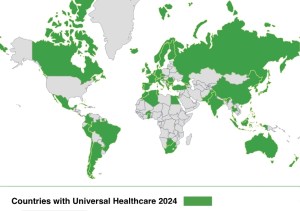 beyond. According to WHO (World Health Organization), France is ranked one of the highest healthcare systems to run a universal coverage for its residents, by covering most costs on hospital, physician and long term care. Today, France is one of the 73 countries in the world providing universal healthcare, along with Australia, Brazil, Canada, China, Finland, Germany, Italy, Mexico, Singapore and UK etc.
Sports unite the world
Ce qui est olympique est universel.
What Is Olympic Is Universal.
-Pierre de Coubertin (1863-1937)
Open and green, Paris 2024 goes down in history for their colorful venues in and around Paris, record-breaking performance by athletes, impressive sustainability and inclusive on and off the field. To make it the most colorful, most diverse and most sustainable Games ever, Paris 2024 worked massively on its image and legacy with more accessibility and full gender parity, while endeavoring to promote younger, inclusive, urban and sustainable sports with the global community.
Through the modern Olympic Movement, sports have contributed to the harmonious and well-balanced development around the world. Blue, yellow, black, green and red, the 5 Olympic rings interconnect each other to represent the 5 continents united by Olympism. Plus a white background, the 6 colors symbolize the colors of all the nations and all the world’s flags for a true international emblem.
The interaction between sport, education and culture is particularly highlighted by Paris 2024, with a focus on bringing more sports to more people for local and international communities. Since day one, the Games were wide open, and delivered with the Olympic flame, which symbolizes the light of spirit, knowledge and life, then continued with the Paralympic flame that signifies peace, goodwill and hope to inspire the world.
 With the groundbreaking slogan of Games Wide Open (Ouvrons Grand les Jeux), Paris 2024 was transformed into a huge open space for pubic participation and everyone can be part of it. Openness is everywhere in blue, white and red: outdoor openings, fireworks over the Seine, Parisian architecture and historic monuments, open air sports arena and tons of celebration sites…After 4 weeks of athletic achievements and sports celebrations, the flame is extinguished for Summer Games, and the torch will forever remain as the symbolic and iconic object of the Paris 2024 Games.
Now the exciting competition is finished in Paris, epic Games and unforgettable experience were created with the largest international sporting events this summer: New world records were set in many sports, accessible and inclusive competition took the stage where unity and equality succeed, more and more women take part to close the gender gap in the world of sports…There is nothing like sports, which build bridge and bring people together with exciting action and emotional celebrations.
At Stade of France, the dazzling closing ceremonies for both Games were filled with spectacular shows, artistic performance, music, dance and fireworks. The Olympic and Paralympic flags were officially handed over to the next host city – Los Angeles, where the Summer Games will take place in 4 years. After London and Paris, Los Angeles will be the 3rd city in the world to host the Summer Games for 3 times in 2028.
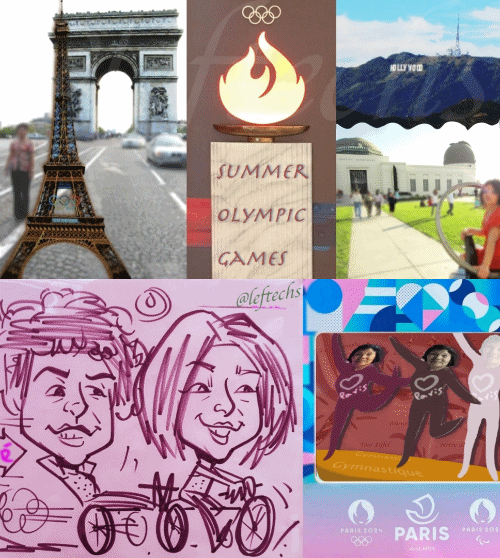 We spent a summer rendez-vous with lots of good times and inspirations: Olympic dreams, sporting excellence, athletes’ achievement, sustainable games, low-carbon construction and temporary infrastructure for reusing and reducing emissions…what do we remember about Paris 2024?
Open wide and going green, sustainability is the key before, during and long after the Summer Games in Paris. High tech sports gear for high performance, from chip-embedded technology to 3D digitalization, more and more green manufacturing are used for sporting products. Renewable energy, ecological transformation, circular economy, eco-friendly facilities and environmental initiatives are largely developed by Paris 2024 in many innovative ways:
– Powered by biofuel, H2 or batteries, 100% renewable energy were used for the Games, to limit diesel generator usage, and reduce a carbon footprint by half than that of previous one
– 95% preexisting venues were used and renovated, to grid-connect renewable power and offer twice as many plant-used food options
– About 5000 sq. meters of rooftop were covered with solar panels at the aquatic centre, and the seats were made with local recycled plastic
– At cafeterias, coffee tables are made from recycled badminton shuttlecocks and drone-like buoys for ecosystem
– Medals are done by the Monnaie of Paris as an eco-friendly production, each of them contains a piece of original iron from the Eiffel Tower. The gold and silver ones are both produced with 100% recycled and certified materials, the bronze ones are made from reused metal scraps, like an alloy of copper, tin and zinc
– The official podiums are featured with the look of the Eiffel Tower and Paris rooftops, an eco-friendly design is created with French wood and 100% recycled plastic
– Silicone replaced plastic as a highly durable and more ocean friendly material from many manufacturing, e.g. a million of silicon bracelets are made in China for the Games and they are recyclable
– Made in China, chip-embedded soccer balls are intelligent for game dynamics, to track the speed, strength and movement in real time
– The nano-coated judo mattresses are resist stains and are easier to be cleaned, they are made in China with high quality and durability to enhance protection and reduce environmental impact
– Produced by local and international manufacturers, the official mascots “ the Phryges” are plush toys using eco friendly materials: 100% recycled stuffing fibers, stitching, embroidery and packaging
– 35 thousand ping pong balls are sent from China to Paris, they are made with top quality with higher elasticity, weight and hardness tolerances. Additionally, a precise ball-serving machine debuted its automation technology in the Olympic Games for the 1st time
– 1200 drones were made in China for the opening ceremony of Paris 2024. Drones are proved as a green technology in many industries, they consume up to 94% less energy than diesel vehicles for efficient transportation
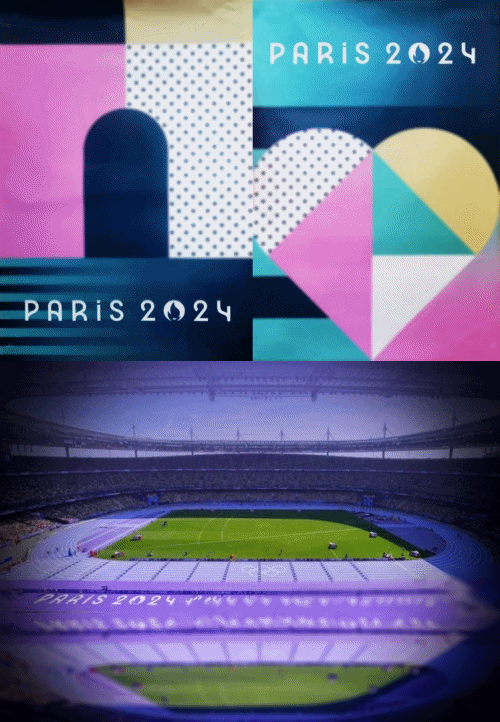 – The Olympic Village will become a new residential district of 4000 homes for 6000 people, including 25% social housing
– In the Paris metropolitan area alone, the economic activity can be generated by the Games between 6.9 and 11.1 billion in Euros.
– Around 180 thousand people got employed in Games-related jobs
– About 80% of Games suppliers are small and medium-sized businesses
vive le vert, vive la lune
A sporting summer with Paris 2024 is nearly ending, but the legacy remains for more ecosystem and sustainability, and green living is never ending. Last month, the annual Perseids lighted up the night sky with a spectacular show as one the most popular metro shower, which even had the peak time on the closing night of Paris Olympics. Up to 100 meteors per hour were visible on the night of August 11-12 in Northern Hemisphere, they were bright and colorful, what a wonderful sky show alongside of Paris Games!
This is only the beginning, more exciting sky wonders are on the way through the following months. A rare super blue moon appeared on the 19th last month as the 2nd full moon in the same month, the combination of the 2 lunar events usually occur once every 10 years, when the moon orbits at its closest point to earth. A full moon generally comes with the lunar cycle of 29.5 days in every month, and supermoons are full moons but much bigger and brighter, only about 3 or 4 ones in a year when the moon gets closer to our planet. A seasonal blue moon is also a full moon that doesn’t appear blue in color, it’s the 2nd full moon in the calendar month, more rare to display only once very 2-3 years.
Full moons are beautiful and shinning, with scientific values about potential effects and influences on earth. If you missed the one last month, there are 3 more full supermoons coming up in a row:
– Super Harvest Moon on September 18, about 357 thousand km between the moon from earth
– Super Hunter’s Moon on October 17, about 357 thousand km between the moon from earth
– Supermoon on November 15, about 360 thousand km between the moon from earth
Green summer will be ended this month, golden autumn is just around the corner, more natural adventures and seasonal celebrations are coming next for green living: International Observe the Moon on Sunday Sept. 14, Mid-Autumn Festival and Harvest moon on Sept. 17-18, autumn equinox on Sept. 22…
From French tricolor of blue, white and red to open games, from powerful sports to green living, Paris time is unforgettable, and sports united the world. It has the power to make dreams and break dreams, it gives people hope, and a voice, it brings people together and gives people a place to belong. There is no one who wins big or less in the major sports movements, where only the revolutionary spirit shines and drives change on everything: people, games, world, health and green living.
Les Jeux Olympiques ne sont point de simples championnats mondiaux, mais bien la fête quadriennale de la jeunesse universelle, du “printemps humain”, la fête des efforts passionnés, des ambitions multiples et de toutes les formes d’activité juvénile de chaque génération apparaissant au seuil de la vie.
– Pierre de Coubertin, père des Jeux Olympiques modernes
More to read: evolution of the Paralymipic movement
– 1948, a sporting event was organized by German neurologist Sir Ludwig Guttman, at a hospital for war veterans in Stoke Mandeville, England, included a wheelchair competition with 16 injured servicemen and women who took part in archery. It’s called the Stoke Mandeville Games as a milestone in Paralympic history.
– 1960, the Paralympic Games was first took place in Rome, Italy, included 400 wheelchair athletes with disabilities from 23 countries to compete in 8 sports: athletics, wheelchair basketball, swimming, table tennis, archery, snooker, wheelchair fencing and dartchery (a combination of darts and archery). It’s the 9th International Stoke Mandeville Games, since then they have taken place every four years.
– 1976, the 1st winter Paralympic Games were held in Sweden, and the 5th Summer Paralympics were hosted by Toronto Canada.
– 1984, the name of Paralympic Games was officially approved and used instead of International Stoke Mandeville Games.
– 1988, the Paralympic Games were held after the Olympic Games in Seoul Korea, with 3057 athletes from 60 countries. It’s the 1st time in history for the both Summer Games that took place at the same site.
– 1989, the International Paralympic Committee (IPC) is founded on September 22.
– 1992, the 5th winter Paralympic Games and the 16th winter Olympic Games were both held in Tignes and Albertville, France. It’s a historic first for the Winter Games that took place at the same venue.
– 2001, an agreement was signed by the IPC and IOC (International Olympic Committee) to let the host city that organizes both Games from the Beijing 2008 onwards, by using the same sporting venues, facilities and athletes’ village, as well as the same entry fees and travel expenses.
– 2004, the 12th Summer Paralympics were held in Athens, Greece, where it had a shared organizing committee with the Summer Olympics for the 1st time.
– 2008, the 13th Summer Paralympics were held along with the 29th Summer Olympics in Beijing, China. A total of 3952 Para athletes from 146 countries participated in about 475 medal events across 20 sports.
 – 2016, the 15th Paralympic Games was landed in Rio de Janeiro, Brazil, and the 1st time in South America. About 4330 athletes from 160 countries participated in 528 competitions for 22 sports, including 2660 men and 1670 women participants.
– 2024, the 17th Summer Paralympics was held in Paris as its 1st Paralympic Games, and the 2nd time in France after its hosting Winter Paralympics in 1992.
 LefTech International