
Harvest: a noun comes from the Old English word for autumn as hærfest and means the season of gathering crops and celebrating golden nature at its best.
Fall season is usually from late September to early December as a busy time for farming work. After many months of planting and tending crops, it’s the harvest time for farmers to reap, collect and store annual crops like wheat and corns with the accumulation of hard work. Filled with abundance and joy, the harvest season is a culmination of what has been grown to be celebrated around the world.
Now we are in the midst of the harvest season, which is a perfect time to work on magic for prosperity and gratitude. From growing crops to harvesting food, the seasonal celebrations are associated with a social importance and nature events found in many cultures and places, such as fall equinox, Harvest Moon, Mid-Autumn Festival, World Food Day and Thanksgiving.
Fall sky wonders
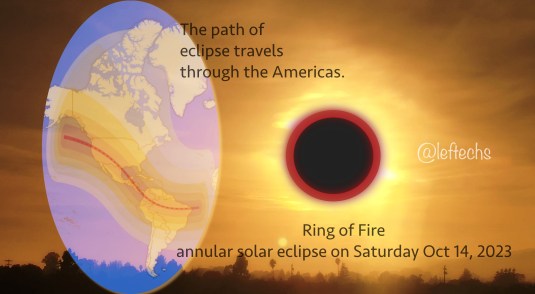
A rare ‘ring of fire’ eclipse is coming this week across the Americas. Look up the sky on Saturday October 14 for a partial or full annular eclipse experience, and don’t forget to view it with proper eye protection.
An annular solar eclipse occurs when the New Moon moves in front of the sun and appears smaller than the sun, so the moon doesn’t completely cover the sun’s disk as it is farther away from Earth. As a result, both of them overlap each other to produce the glowing ring in the sky and create a “ring of fire” at certain times and places.
It is a special celestial display since not every New Moon can be visible to make an eclipse happen. Normally we don’t see the New Moon from Earth except during solar eclipses, where it passes the sun and silhouettes against the Sun for a total, partial, annular or hybrid effect. For any solar eclipse to take place, it has to be around New Moon near its farthest point from Earth, when the Sun and Earth are aligned on opposite sides of the Moon to form a straight line of Earth-Moon-Sun.

The upcoming annular eclipse has a typical 5 stages of contact from partial beginning to full eclipse like the annularity, when the moon doesn’t block the sun entirely and instead leaves its bright outer edges visible, until covers its centre with a fiery ring or annulus around the moon like a narrow circle shape, then annularity and partial eclipse ends one after the other. From start to finish, the total duration lasts about 6 hours along the way and about 3 hours in locations where it is visible.
It will start over the pacific ocean around 8am PDT and move on west coast to southeast along a swath about 125 miles wide for the best viewing of annularity. The narrow path travels about 4000 mph across North to South America through part of Canada and US, all the way down Mexico and Central America to Colombia and Brazil. During this eclipse path, the estimated time of darkness is about 5 minutes, when the moon like a dark disk on top of the sun’s larger and bright disk, only a ring of light is visible in the sky.
If you plan to view it, remember to protect your eyes and never look at the bright sun directly without right protection for solar viewing. Otherwise your eyes could be severely injured in an instant, as the Sun’s rays can burn the retinas in the eyes leading to permanent damage or even worse. A safe way to watch a solar eclipse is to wear protective eclipse glasses or to project an image of the eclipsed Sun using a pinhole projector. If you use a camera lens, binoculars, or a telescope to view and photograph, be sure to place a special-purpose solar filter secured over the front of the optics for doing so.
Well, this celestial phenomenon won’t happen again in North America until 16 years later, so catch it this week safely!
This fall harvest, the ring of fire is the 1st eclipse but certainly not the last one. Actually an eclipse never comes alone, and we are in the eclipse season to highlight the October skies. Every eclipse season is about 35 days with 2 to 3 eclipses in a row including 1 lunar eclipse at least, and a solar eclipse always occurs about two weeks before or after a lunar eclipse.
Solar eclipses only happen with a New Moon, which passes between the Earth and the Sun. And lunar eclipses only happen at full moon, which is on the opposite side of Earth to the Sun. In other words, Earth comes between the sun the the moon to block the sun’s rays unreaching the moon directly, since the moon shines by reflecting the sun’s rays on its surface without own light. Therefore lunar eclipses are very safe to look at with the naked eyes, unlike solar eclipses exposing some risks to bare eyes.

Depending the weather conditions, 3 kinds of lunar eclipses can be visible in the night sky including total, partial and penumbral ones. A lunar month takes about 30 days to go through all of 8 phases from new moon to full moon, so the next and 2nd eclipse this season will occur 2 weeks later at the end of the month as a partial lunar eclipse, which can be seen greatly in Europe, Asia, part of North and South America etc.
Along with this lunar eclipse, the October full moon is called Hunter’s moon and visible everywhere on the night side of the world. It will rise together with planet Jupiter close to each other, so look up these 2 brightest objects in the sky for quite an impressive sight. The Hunter’s Moon is the first full Moon after the Harvest Moon, which usually happens at the end of September as the full moon closest to the autumn equinox. The both full moons are part of fall harvest to mark a time of preparing and gathering food before winter season comes.
Besides the eclipse season, some other celestial bodies like Saturn and Venus will also show up in the night sky to accompany the moon closely. In the astronomy news, we can look toward the south 1 hour or 2 after sunset to find the Moon about 70% illuminated, hanging just beneath the planet Saturn on October 23.
Eclipses, full moon, perseids and other cosmic highlights, what are your skywatching favorites this harvest season?
Space is calling
Each October, the World Space Week takes place at the beginning of the month with lots of educational workshops, innovative talks and celebrating activities. The theme is Space and Entrepreneurship for this year to highlight the importance and contributions of space science and technology.
The annual event is held to commemorate 2 important dates about space development: one is the launch of the 1st human-made Earth satellite – Sputnik 1 on Oct 4 in 1957 to open the way for space exploration; the other is in recognition of Oct 10 in 1967 entry into force of the Treaty on Principles Governing the Activities of States in the Exploration and Peaceful Uses of Outer Space, including the Moon and other celestial bodies.

Over the decades, the space exploration and international cooperation in outer space have incredibly advanced in shaping global economies and technologies. From rockets to satellites, from moon landing to mars mission, space is not only a driving force to change the world and address global challenges with innovative solutions, and also a great opportunity to achieve the global goals and a more sustainable future for humanity and our planet.
Besides public agencies and services in space research and development, the commercial space industry is getting bigger and wider with more and more entrepreneurial businesses and private companies to design, manufacture and invest for the betterment of the human condition. With a big ambition of colonizing Mars, SpaceX is one of the most well known private space companies that has successfully sent satellites and people to space, including NASA crews to the International Space Station. It’s the 1st manufacture in the world to build the reusable rockets that can carry cargo and astronauts into orbit. It also works on a starship system on a way for lunar landings and crewed mars missions.
Science and technology are the cores of space entrepreneurship and industry, both of public and private sectors have become increasingly involved in space exploration. There are some leading agencies like National Aeronautics and Space Administration(NASA), China National Space Administration(CNSA), European Space Agency (ESA) and Canadian Space Agency(CSA), who are interested in the commercial business and working with the private space services for different programs such as crewed spacecraft, lunar research, space travel to Mars, data products and services etc.
The rise of commercial space brings arguably a robust and competitive progress to heat up the race to space exploration and sustainability. So far the US has the record for the highest number of commercial space launches, followed by the European Union and Russia. China and India have also made it to the list of countries with successful commercial space launches in recent times.
Sky has no limit and space has no border
Get closer to other celestial bodies and land on some planets nearby are one of space dreams for many of us. Just like what happens in the real life, much more failures occur and fewer success has achieved. Landing on another planet is technically challenging and many attempt landings have failed. A human mission to Mars or living on the moon doesn’t work for now, but it doesn’t stop scientific research and technological innovation for Mars landings by robotic and unscrewed spacecraft.
As of today, Russia was the 1st country to conduct Mars probe with its soft landing, followed by United States and China to land on the surface of the red planet successfully for prob activities. Plus 3 countries that have reached Mars by entering into orbit and they are European Union, India and the United Arab Emirates. The moon landing has made more progress with both crewed and robotic missions. 4 nations have successfully achieved soft landings on the lunar surface including Russia with Luna probe, US with Surveyor program, China with Chang’e program and India with Chandrayaan-3 module. Russia was the 1st country to land the moon with an unscrewed rover as Luna 2, and the US is the only country to have conducted a crewed landing on the Moon as Apollo 11.
Starry skies, galaxy wonders, the moon and other cosmic planets…going to space and discovering the universe beyond our planet are much more exciting than ever. Fly to the moon and travel on Mars…more sky wonders and space advancements await us to keep exploring and dream big for humanity and sustainable planet.
Connecting with the land and nature
Occurring every 6 months, the equinox splits Earth’s day nearly in half as the natural marker of seasonal change.
A solar equinox is a moment when the Sun appears directly above the Earth’s equator, neither in north nor south of the equator. It’s a time to divide Earth equally with illuminated northern and southern hemispheres for almost 12 hours of both daytime and nighttime. Equinoxes are the start of the spring and fall with the vernal equinox in March and autumnal equinox in September. Like the summer solstice in June and winter solstice in December, equinoxes are celebrated by people since ancient times.
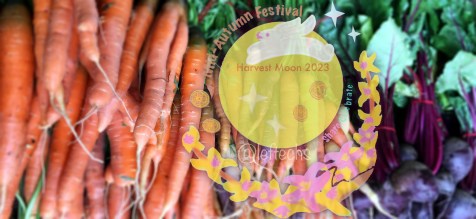
The September equinox ushers in the arrival of fall, now the fall harvest is in full swing with plenty of seasonal food and nature activities. Harvesting is simply the process of gathering mature crops and collecting plants, animals or fish for food. Fall harvest is truly a time to enjoy a wide variety of fresh produce in season: corns, pears, carrots, sweet potatoes, apples, beets, onions, mushrooms, squash, pumpkins…what are your favourite veggies and fruits?



 LefTech International